
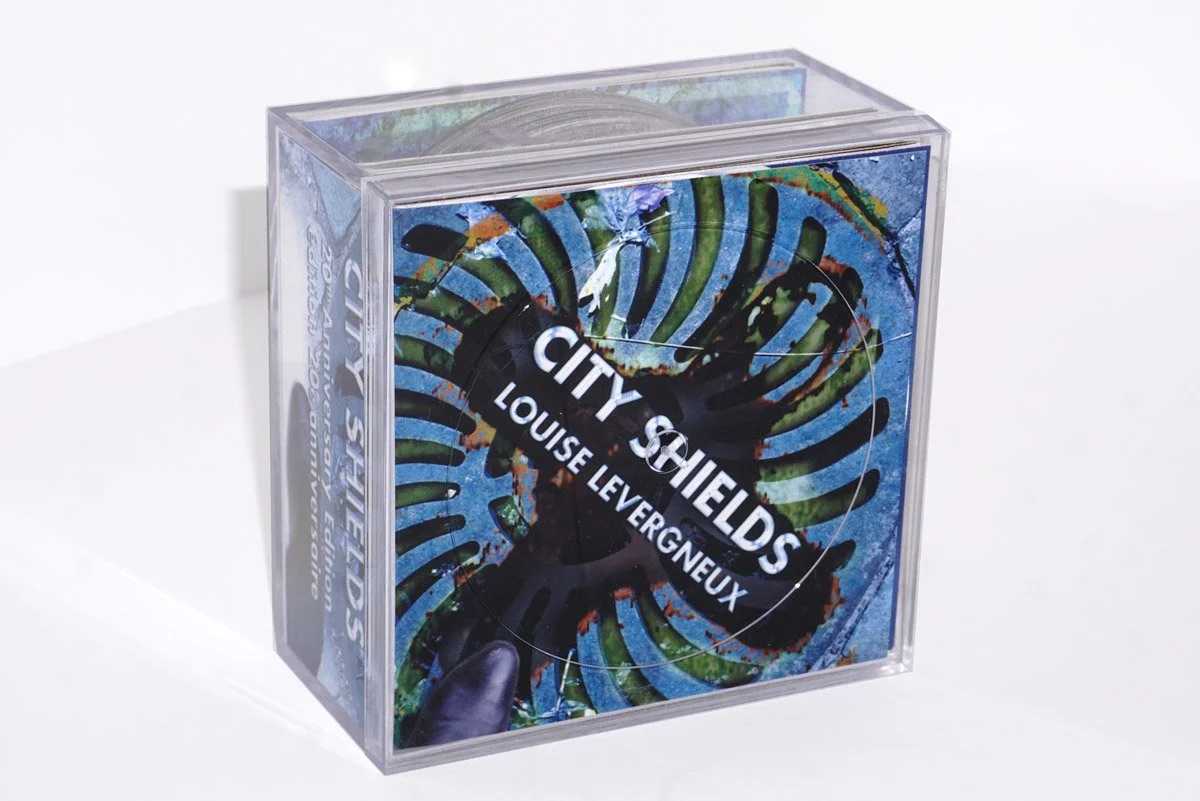
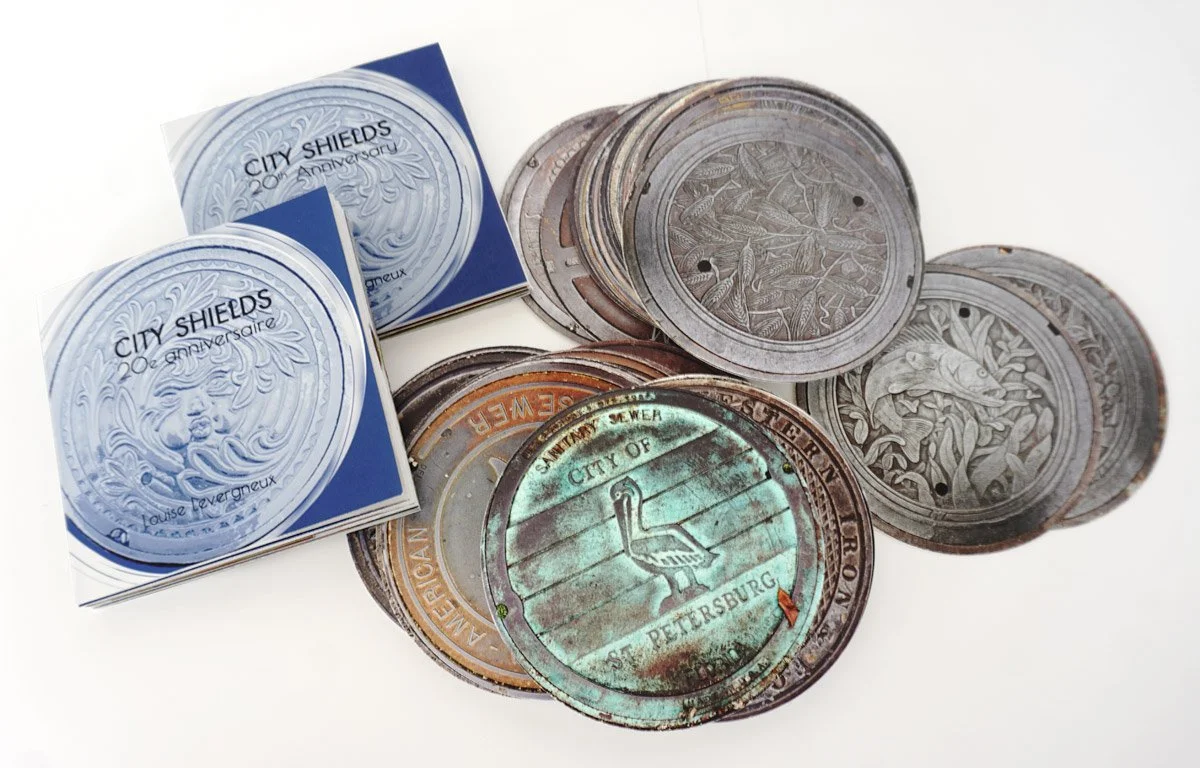
© 2021 Louise Levergneux.This celebratory edition showcases 84 unbound die-cut manhole covers, two accordion books (in French and in English), and inserts from previous volumes. The entire piece is housed in a clear acrylic box.
Since the National Gallery of Canada Library acquired City Shields in 2001, my series has provided a personal perspective on urban infrastructure and travel memories. I’m thrilled that the gallery remains so invested in this project and its relevance to their collection.
Peter Trepanier, Head of Reader Services at the Library of the National Gallery of Canada, wrote about City Shields for the ARLIS /MOQ (Montreal, Ottawa, and Quebec chapter of the Art Libraries Association of North America) in spring 2007. An enthusiast of the series, Trepanier collected every volume I published until he retired in 2017. In his article, he noted that City Shields bridges the gap between the everyday and the extraordinary by transforming overlooked elements of urban infrastructure into objects of contemplation. Peter also noted that my work extends the legacy of German photographers Bernd and Hilla Becher into the realm of pedestrian streets. He reminds us that aesthetic experiences exist beyond museums or grand monuments; we can find them right beneath our feet — in ordinary surfaces that quietly record the passage of time and use. Ultimately, Trepanier believed that City Shields promotes a more mindful approach to navigating the world, turning even the simplest manhole cover into a place of memory, significance, and visual pleasure. The NGC library acquired the final volume, the 20th Anniversary edition of City Shields, in 2022.
A few months ago, Kathleen O’Reilly, Cataloguer at the National Gallery of Canada, reached out to me to feature City Shields in a new article titled 'Artists’ Books: Conceptual, Experimental and Artistic' for the gallery's online magazine, which explores its artists’ book collection.
I was very pleased to learn that my project, which began in 1999 during a trip to Scotland, was still of interest, as they discussed what modern artists’ books are and why they matter. What connects them is creativity, originality, and a focus on ideas. The article explains how artists’ books emerged from 20th-century avant-garde movements such as Dada, Surrealism, Futurism, Expressionism, Conceptualism, and Fluxus. By the 1960s, artists’ books also adopted political meanings, challenging art institutions and markets by offering cheaper, more accessible works. Ultimately, the text argues that artists’ books question traditional art forms and gallery displays, encourage personal, reflective engagement, and play with the relationship between words and images. The National Gallery of Canada’s collection illustrates how diverse and experimental this medium can be.